Field notes to a finished report in under two minutes.
An officer dictates what happened. The draft comes back structured, and audited for the vague force language and missing justifications that get a report torn apart later. Nothing is filed until the officer reviews it and signs their name to it.
Narrative AI is not an RMS and does not replace the one you have. CJIS-aligned. Your reports are never used to train AI models. Runs on the hardware your officers already carry, with no integration work and no IT project.
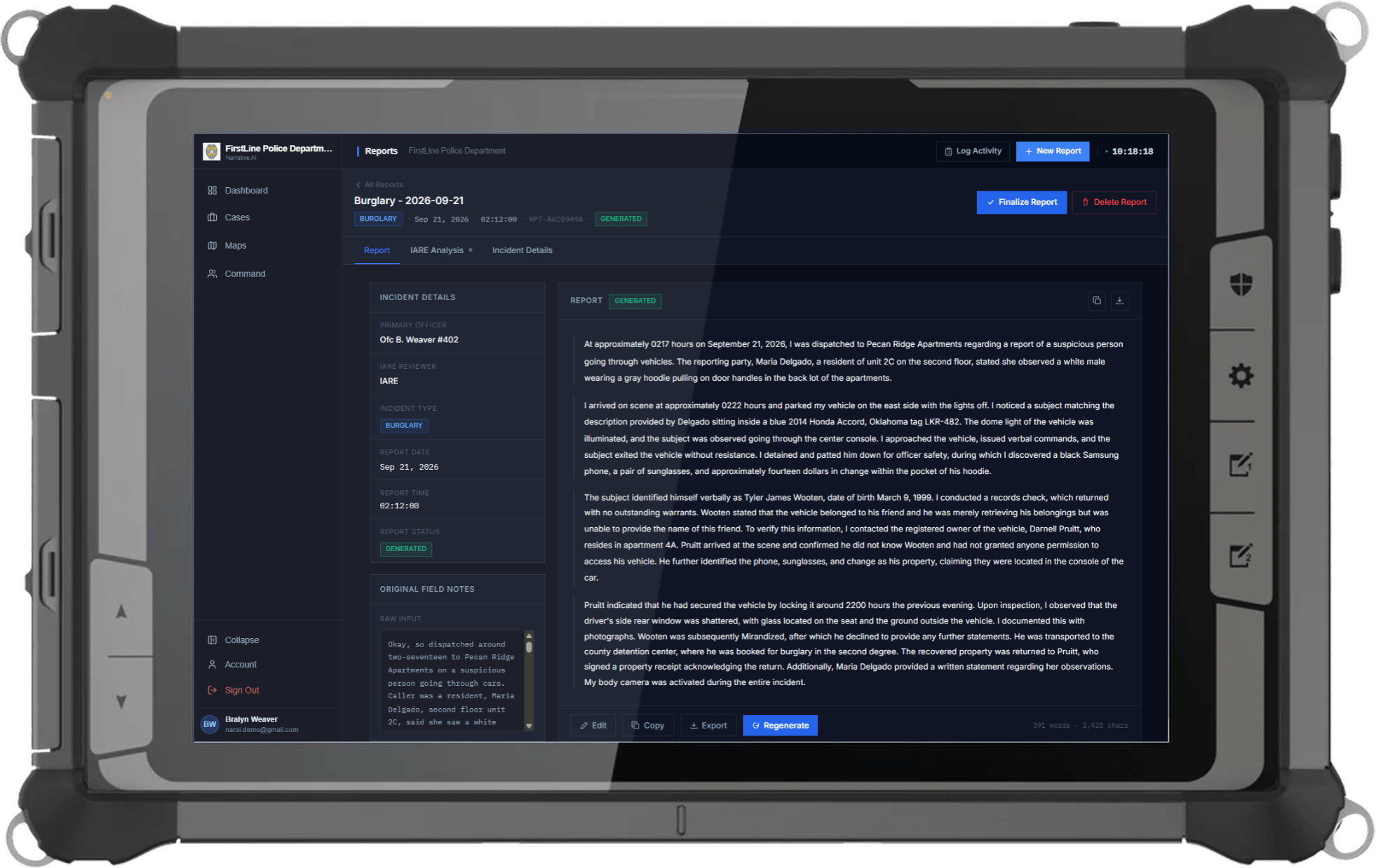
Officers lose hours to reports. Documentation carries hidden liability. Command runs without live visibility.
Deployment runs on habit, not data. Documentation errors surface only once IA is already involved. Narrative AI fixes both in one platform, no new hardware, no RMS integration.
Write. Audit. Command.
One loop: the report an officer writes is the data command runs on.
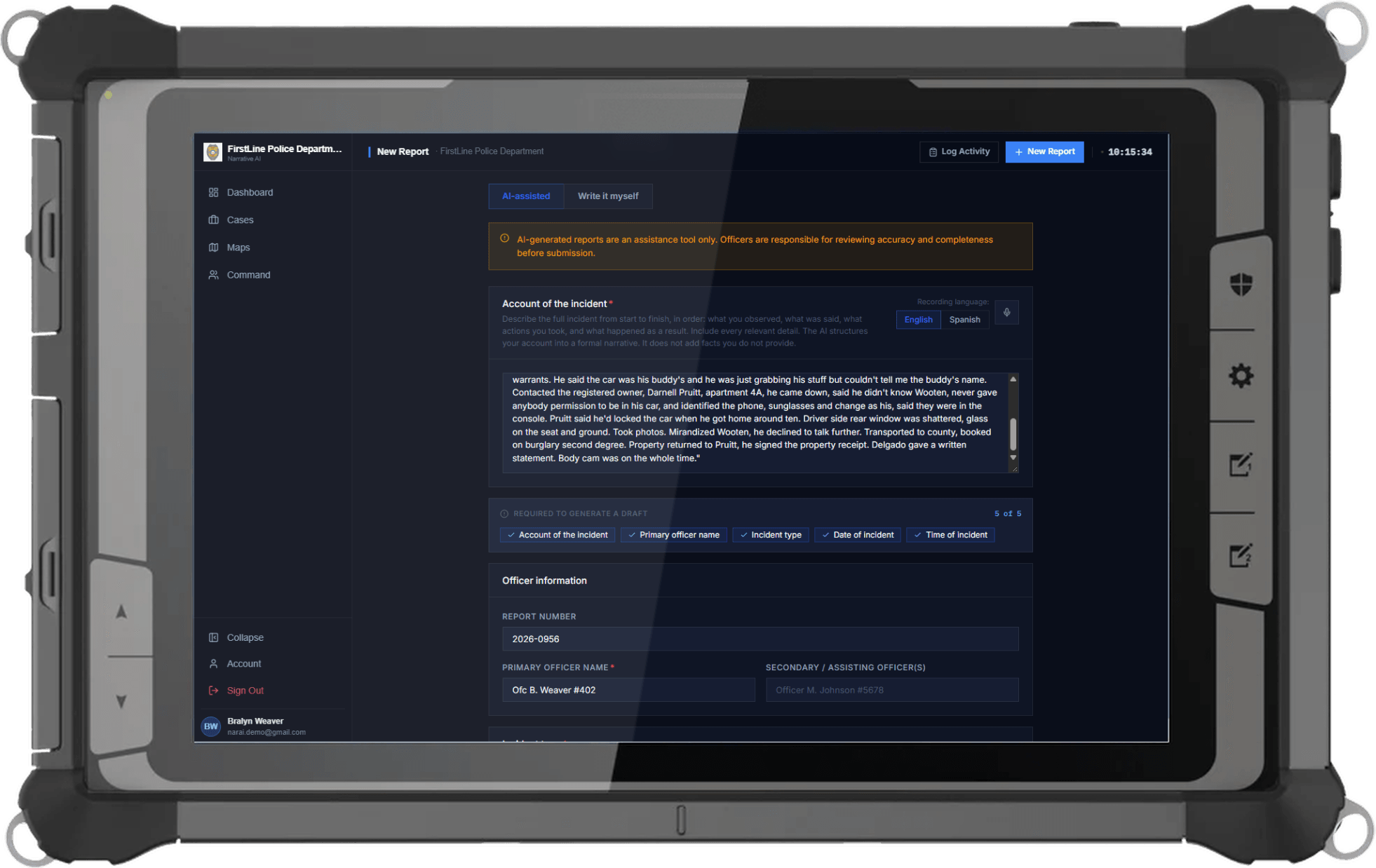
Officers turn their own observations into a structured draft in under two minutes, no new hardware, no RMS integration.
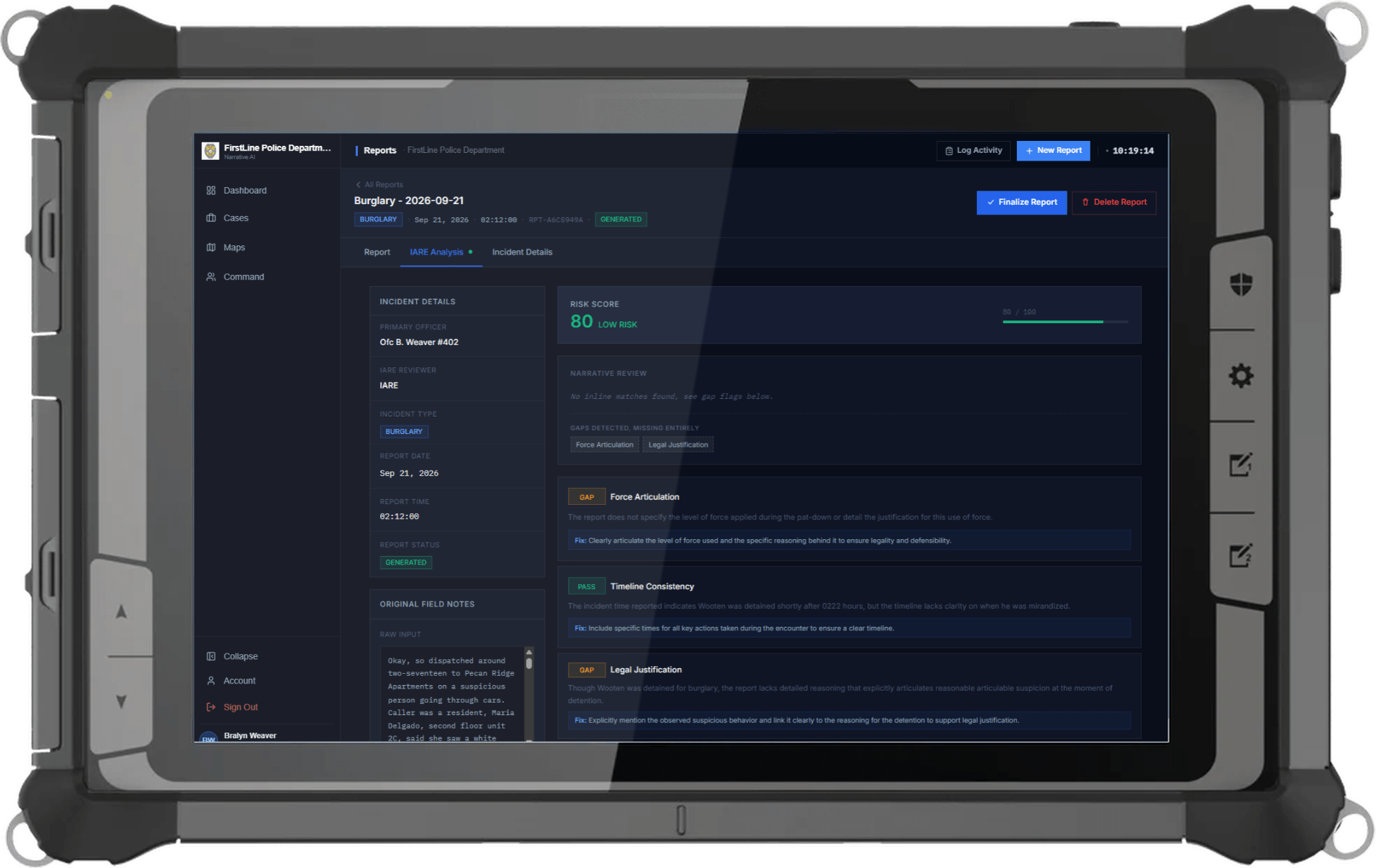
Before submission, IARE flags vague force language, missing legal justifications, and timeline gaps, the same review IA runs after the fact, applied first.
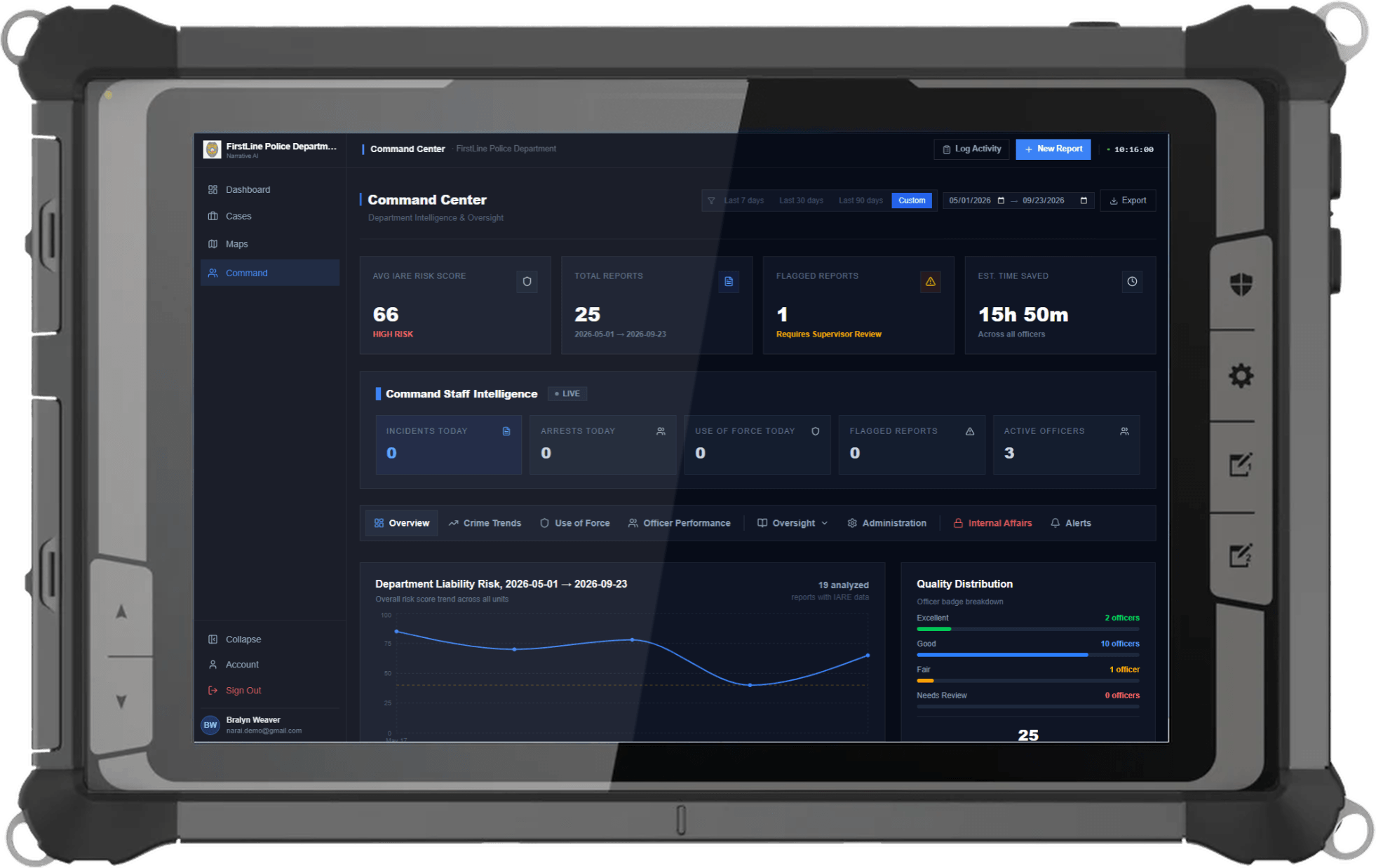
Every report an officer submits feeds the Command Center, call density, officer positioning, and incident patterns update live, so command runs on real field data.
One platform. Four doors in.
Patrol, supervisors, command, and records each get what they need from the same system.
Turn field notes into a structured draft in under two minutes, then review and certify. Works on the device you already carry, no new hardware.
- Draft in under two minutes
- Works on mobile, in the field
- You review and sign, you own it
What Officers Are Saying.
As a patrol officer, Narrative AI has significantly reduced the amount of time I spend sitting in a parking lot writing reports and increased the amount of time I can spend doing what I was hired to do: answering calls, being proactive, and serving my community. For agencies looking to improve efficiency and reduce liability without compromising quality, it is a valuable force multiplier.”
What Narrative AI saves your agency.
Estimate the labor cost your agency recovers when officers spend less time writing reports. Adjust the inputs to match your department.
Estimate assumes a 50% reduction in report-writing time. Figures are illustrative, not a guarantee.
Three Capabilities. One Platform.
Most tools stop at writing the report faster. Narrative AI audits every report for liability before it is filed, and turns each one into a live command picture.
Call density by district, unit positions, active incident flags, and shift-level risk signals. One live picture of the agency that command staff can act on at the start of every shift.
IARE flags vague use-of-force language, missing legal justifications, timeline gaps, and policy misalignments. Each is marked line by line with the exact phrase and a recommended fix. It is the same audit Internal Affairs runs after the fact, applied before the report is submitted.
The officer provides the account; the system structures it into a draft. The AI drafts, the officer reviews and certifies. Every report passes through IARE before it leaves the field. No new hardware, no RMS integration required.
The live picture command runs on.
Every report an officer submits updates the agency picture, risk scores, report volume, flagged reviews, and officer activity, live.
Every report audited for liability before it leaves the field.
The same audit Internal Affairs runs after the fact, applied before the report is submitted. Each finding is flagged line by line with the quoted phrase and a recommended fix, and the report gets a 0–100 liability score.
- Use-of-force language risk scoring on every narrative.
- Missing-justification detection (reasonable suspicion, probable cause, detention).
- Command-level liability oversight across the agency.
What a draft looks like.
On 04/22/2026 at approximately 2247 hours, this officer (Badge #4471) responded to a disturbance call at 4400 West Division Street, Unit 3B, in reference to a domestic dispute in progress. Dispatch advised that the reporting party could hear shouting and breaking objects from inside the residence.
Upon arrival, this officer made contact with the subject, later identified as John Michael Doe (DOB: 08/14/1989), in the hallway of the third floor. The subject displayed aggressive behavior, including advancing toward this officer while raising his right hand in a threatening manner. This officer verbally ordered the subject to stop advancing on three separate occasions. The subject failed to comply.
This officer deployed a single application of department-approved OC spray to the subject’s facial area from a distance of approximately six feet. The subject immediately ceased his advance, was directed to the ground, and was placed in handcuffs without further incident.
You own what you sign.
Narrative AI produces a draft. The officer provides the facts, reviews the draft, and certifies it, and then it is the officer’s report.
Narrative AI structures the account; it never files it. No report leaves the field until an officer has reviewed, edited, and signed off. AI assists, it never replaces officer judgment.
The draft reflects only what the officer reported. It does not invent details, fill gaps, or add interpretation. Missing information is flagged for the officer to complete, never guessed.
The system records the officer's review and certification, creating an accountability trail that shows proper officer involvement if a report is ever questioned.
Built with law enforcement, not just for it.
The idea came from inside the profession and was shaped by senior law enforcement leaders, so the report, the audit, and the command picture reflect how policing actually works.
Narrative AI started with a working officer's idea, not a tech shop guessing at what a report needs.
Senior law enforcement leaders defined how report writing, liability review, and command oversight had to work to be trusted in the field.
Documentation, IARE's liability checks, and the command picture are mapped to how agencies actually write, review, and run a shift.
Built for procurement review.
RMS compatibility, CJIS-aligned security, and deployment without an IT project.
Reports export via PDF or copy-and-paste, compatible with Tyler New World, Motorola PremierOne, CentralSquare, and more. No integration required.
Built with CJIS Security Policy requirements in mind. Azure migration underway. Data encrypted in transit and at rest. No training on submitted data, and retention disabled on every call. Your case data stays yours.
FBI CJIS Security Policy ↗The agency receives a join code. Officers create accounts by email and begin generating reports. No hardware, integration project, or IT provisioning is required. Typical deployment completes within 48 hours.
Why not just use a public AI chatbot?
An officer can paste notes into a general-purpose AI and get paragraphs back. Here is what that shortcut leaves on the table, and why, for law enforcement, it is a liability rather than a savings.
- Sensitive incident details are sent to a public service, outside your agency’s control.
- No CJIS-aligned handling. Your data may be retained or used to train the model.
- No liability review, nothing checks the narrative before it is filed.
- No record that an officer reviewed or certified the report.
- Generic output. The officer reformats, restructures, and copy-pastes it by hand.
- It does not know incident types, legal justifications, or your agency policy.
- CJIS-aligned handling, no training on your data, retention disabled on every call.
- IARE audits every report for liability before it leaves the field.
- The officer’s review and certification are recorded, a defensible accountability trail.
- Structured for police reports and built to export into any RMS.
- Built around incident types, legal justifications, and your agency policy.
- The officer stays the author, grounded in the facts they provide.
Agency-Only Pricing.
Exclusively for law enforcement agencies. Every engagement begins with a 30-day evaluation pilot, then continues as a one-year term at $24.95 per officer per month, billed annually.
Billed annually · Agency accounts only
- Command Center, live agency picture every shift
- IARE Risk Engine on every report
- Unlimited AI report generation, all 40+ incident types
- All officers under one agency account
- Works with any RMS, no integration required
- CJIS-aligned security (Azure migration underway) · no training on your data
Law enforcement agencies only.
Common Questions from Chiefs & Administrators.
Request an agency pilot.
A 30-day evaluation across Command Center, IARE, and AI-assisted report writing, provisioned for your agency on request.
Contact us at info@narrative-ai.org for enterprise pricing.